My Story
The long way round.
Roads, bridges, and a restless mind
After leaving school, I spent my first ten years in civil engineering, designing roads and bridges. It was solid, respectable work. But I kept getting pulled away from the drawing board (if you are under 30, Google what a drawing board is) to fix the office computers, and I discovered I had a talent for "doing things with computers" that I enjoyed far more than what I was being paid to do.
The computer shop years
I started my first business, a computer hardware supply shop. This was my first experience of being a slave to a business. Working 60-plus hours a week, I had a wife and daughter who barely recognised me. The freedom I thought I'd get from working for myself was a dream. But I learned something valuable: people don't buy from whoever is cheapest. They buy from someone they like and trust, someone who gives good advice and has their interests at heart.
The cabling guru
My biggest client owned a large office interiors company. He kept asking me to talk to his clients about network cabling, and started introducing me as "the cabling guru." Because I was introduced as an expert, people listened. They took my advice and bought what I suggested, which was always exactly what they needed.
I became so good at winning his clients over that he decided I should work for him directly. As he was my biggest customer, he had the upper hand. He bought the computer business, and I became employed again.
Something surprising happened next. Clients started asking me about everything to do with their office fitout project, not just cabling, but furniture, lighting, and partition walls. They trusted me. Selling became easy when I listened to what people wanted and suggested the right solution. I earned a reputation with clients for giving great advice and with the company for getting clients to buy everything for their project from me.
This accidentally led to me becoming "Sales Director." I hated the title. I had never sold anything, clients had simply bought what they needed, having had it explained to them. Unfortunately, the company had already printed the business cards.
Going it alone (again)
In 2007 I set up on my own again, offering business consultancy and project management to SME's. I'd completed a three-year MBA part-time at university while working a 60-hour week with two children and a very understanding wife.
Over that period, I truly learned what it means to be busy.
But the lifestyle of long hours, working breakfasts, business lunches, and hotel dinners had taken its toll. By the time I was 39, I weighed over 21 stone (nearly 300lbs). At 5'8", that gave me a BMI over 40, a 44-inch waist, and the clinical label "morbidly obese."
Sometimes the universe throws you a lifeline
I was waiting in the reception area at a client's office, early for a meeting, when I had a chance encounter that was to change the course of my life.
By strange coincidence, another man was sitting in the reception area that day, waiting for an unrelated meeting. I was introduced to him by the receptionist, who said he had come to meet a colleague of mine about project management advice for a clinic he wanted to open.
As my colleague was late, the receptionist decided to play matchmaker and introduced us, knowing that's what I did! After the usual formalities, I asked what type of clinic it was. After a long and uncomfortable silence, the answer came back: "A weight management clinic." Tipping the scales at nearly 300 lbs, I was definitely in his target market!
I said: "I'll help you if you can help me."
Over the following 12 weeks, I helped the man I had met by chance in that reception area that day open his weight loss clinic in Cheshire. On 15 June 2009, I became his first patient and embarked on the most amazing journey of my life, losing 7 stone 2lbs in 20 weeks under close medical supervision, without surgery, without drugs, and without the loose skin associated with rapid weight loss.
By November 14th 2009, I had lost the equivalent of an average 12-year-old child in weight.
The madest idea (my entrepreneurial seizure)
Shortly after completing the weight loss programme, I was on a flight back from Dubai, where I had been delivering a project for the most ungrateful client I had ever worked for. It was mid-flight when I had one of those "what the hell am I doing with my life" moments.
I knew there had to be more to life than helping people build new offices.
My outlook and attitude had changed completely. People who knew me before my weight loss journey, even highly successful people I'd worked with professionally, started confiding in me, sometimes very emotionally, about how unhappy they were with their weight. I found myself talking, and people hanging on every word of my story.
After the in-flight meal had been cleared away, I had the maddest idea. I was going to give up my career in consultancy and open my own weight loss clinic.
My only qualification for this endeavour was that I had been fat and had lost weight! I knew nothing about running a clinic and had no background in healthcare. In my favour, I did have an MBA, which I came to discover meant Means Bugger ALL (MBA) when it comes to actually starting and running a business in which you have zero experience.
My wife Rachel more accurately described what followed as a "mid-life crisis." I had no job, no income, four children to support and no idea how the hell I was going to open and run my own clinic. But I knew I had a burning desire to help overweight people not feel as miserable as I had when I weighed nearly 300 lbs.
Building a national clinic chain
After much stress and several setbacks, in July 2011, I opened my first clinic, the Silverlink Clinic in Newcastle. I was the first non-medic to be granted a licence to open such a clinic.
I went from managing 30 or 40 testosterone-filled blokes with power tools to managing an entirely female team of therapists and doctors. I am definitely in touch with my feminine side now.
That one clinic grew into 10 of our own clinics and 25 franchise partners across England and Scotland, with a team of over 120 doctors, therapists, and patient support staff, helping hundreds of patients each week.
Over the next 10 years, we helped more than 10,000 people lose a combined weight of over 20 tonnes, which is about the weight of two double-decker buses, and transform their lives and health.
Along the way, I discovered the system that kept the whole thing running:
Simplify, Systemise, Automate, Monitor, Manage.
That same philosophy drives everything I do today.
In January 2023, I sold the business to an investment company. The clinic chapter was done, and the AI revolution was just getting started. I was hooked when a friend showed me this little tool on his phone called ChatGPT.
Back to my roots, through AI
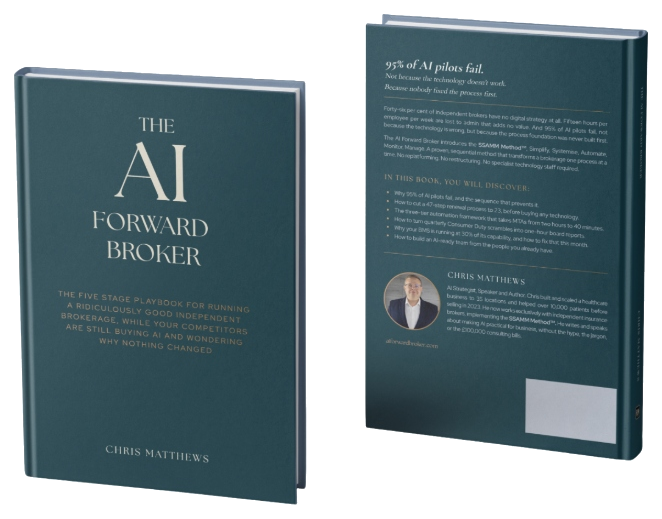
After the exit, I went back to where it all started: technology. Now I work as an AI Strategist, Speaker & Author, helping business owners cut through the overwhelming noise of AI and find the practical applications that actually move the needle. The SSAMM Method™ is the system I use to get them there.
It's the same pattern it's always been. Listen. Understand what people actually need. Give good advice. Make it easy for them to take the right next step. Whether I was explaining network cabling in 2001 or AI implementation in 2026, the principle hasn't changed.
I also use an analogy that has been with me since the very beginning: trying to adopt AI today is like standing at the foot of Niagara Falls with a teacup. What you need is a glass of water, but the teacup is the wrong tool for the job, and the volume overwhelms both you and the cup. My job is to help businesses get their glass of water.